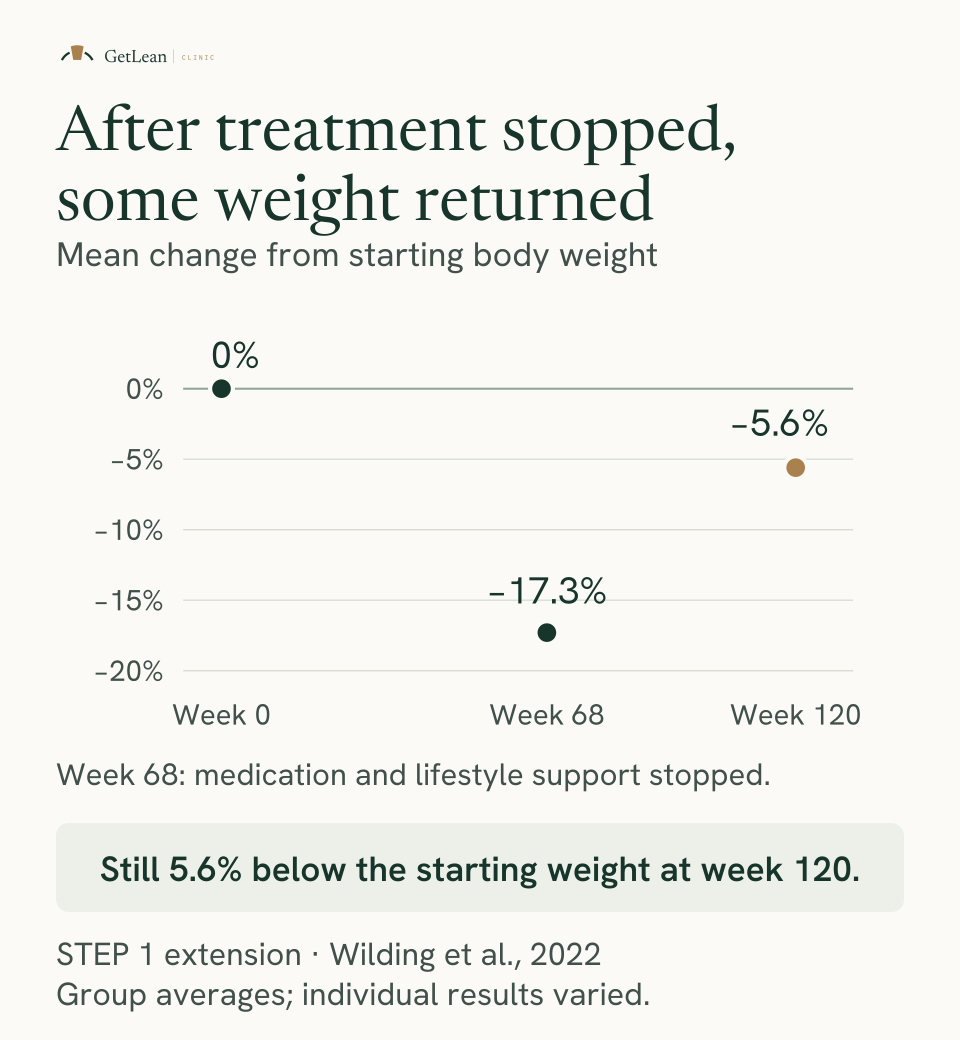
About two-thirds of the weight lost came back within a year when semaglutide was stopped overnight in the STEP 1 extension (Wilding 2022). Participants who had lost 17.3% regained 11.6 percentage points, finishing 5.6% below their starting weight on average, and in SURMOUNT-4 weight rose 14.0% on average in the 52 weeks after a switch to placebo (Aronne 2024); individual results vary. The GetLean GLP-1 Taper Plan plans your taper from the first consultation with Dr Quek, toward the lowest effective dose and, where clinically appropriate, off the medication.
They had lost it over 68 weeks on semaglutide, and the medication and the trial's lifestyle support stopped on the same day, with no taper; the standard deviation around the regain was 7.7 points. Pooled trial data show the regain is fastest in the first months and then slows (Budini 2026); individual results vary.
In Singapore, tirzepatide is registered as Mounjaro, and semaglutide injection as Wegovy for weight management and as Ozempic for type 2 diabetes. The figures in this article are given by molecule, as the trials and product labels report them.
Withdrawal trial: a study where people who have lost weight on a medication stop taking it, either by switching to placebo or by ending treatment, so the effect of stopping can be measured.
What do the withdrawal trials show?
The withdrawal trials took the medication away: the STEP 1 extension stopped it overnight, with no taper, and SURMOUNT-4 switched people to placebo. The figure most often quoted comes from the STEP 1 extension, where the trial's lifestyle support ended on the same day as the medication.
In the STEP 1 extension, participants lost 17.3% of body weight over 68 weeks on semaglutide. The medication and the lifestyle intervention then both stopped at week 68. In the year that followed, they regained 11.6 percentage points of that loss, about two-thirds of it, finishing at 5.6% below their starting weight (Wilding 2022).
In SURMOUNT-4, with tirzepatide, 670 adults who had lost 20.9% of body weight on average over a 36-week lead-in were randomised to continue tirzepatide or switch to placebo for 52 weeks. On placebo, weight rose by 14.0% on average from week 36 to week 88, and 16.6% still held at least 80% of the weight lost in the lead-in. At week 88 the placebo group was still 9.9% below its starting weight on average (Aronne 2024).
Why does the weight come back after an overnight stop?
Because the appetite effect fades. GLP-1 medication works by changing appetite signalling — reducing hunger and the intrusive preoccupation with food that patients often describe — while it is being taken. Stopped overnight, that effect fades over the following weeks, and the habits in place by then are what is left. That is biology, not a lack of willpower.
When you have reached your goal weight and want to come off your GLP-1 medicine, stopping all at once is usually the hardest way to do it. The GetLean GLP-1 Taper Plan brings your appetite back gradually instead: each step lets a little hunger return, so you can get used to your own hunger cues again and rely on the habits you built with us before you take the next step down. At GetLean, microdosing means taking the medicine below its labelled dose or schedule, and the GetLean GLP-1 Taper Plan gets you there in two ways, and often uses both: GLP-1 microdosing at GetLean, step by step.
The parts of the number that get dropped
Three things about "two-thirds" are routinely lost in the retelling, and all three matter.
It is an average with wide spread. The STEP 1 extension reported a standard deviation of 7.7 percentage points around the regain figure (Wilding 2022). Some participants regained far more than two-thirds; some regained far less. An average describes the group, not the person reading about it.
Regain slows down. Pooled trial data show the regain is fastest in the first months and then decelerates, rather than running in a straight line back to the start (Budini 2026).
People end up lighter than they started. A year after the overnight stop, the STEP 1 extension group was still 5.6% below its starting weight on average (Wilding 2022). "You put it all back on" is not what the trials found.
The STEP 1 extension figure, with the three parts of it that usually get dropped.
| Part of the figure | What the source reports | Source |
|---|---|---|
| The figure | After semaglutide and the lifestyle intervention both stopped at week 68, with no taper, participants regained 11.6 percentage points of a 17.3% loss in the year that followed, about two-thirds of it | Wilding 2022 |
| The spread | A standard deviation of 7.7 percentage points around the regain figure | Wilding 2022 |
| The pace | Pooled trial data: fastest in the first months, then decelerating rather than running in a straight line back to the start | Budini 2026 |
| The end point | A year after the overnight stop, the group was still 5.6% below its starting weight on average | Wilding 2022 |
What separates the people who keep it off?
The habits they keep. Holding a loss is more common than its reputation: about one in five people with overweight lose at least 10% of their body weight and hold it for at least a year (Wing & Phelan 2005).
The National Weight Control Registry tracked 784 people who had lost at least 13.6 kg and kept it off for five years on average, with a mean loss of 30 kg. They reported a low-fat diet — 24 ± 9% of energy from fat — and a high level of physical activity, around 2,828 kcal a week, which is roughly an hour a day (Klem 1997).
Following registry members for a year, 59% maintained their loss and 35% regained. Regain was more likely in those whose loss was recent rather than established, those who had lost a larger share of their maximum weight, and those with higher levels of depression, dietary disinhibition and binge eating. Those who regained showed decreases in energy expenditure and restraint, and increases in dietary fat and disinhibited eating (McGuire 1999).
The registry is observational: it records what people who kept weight off report doing. It also shows that maintenance gets easier with time. Once a loss has been held for two to five years, the chance of longer-term success rises substantially (Wing 2001).
Exercise also counts after a GLP-1 medication stops. In a Copenhagen randomised trial that followed adults for a year after treatment ended, those who had combined a GLP-1 medication with supervised exercise were more likely than those who had taken the medication alone to still hold a loss of at least 10% of their starting weight (Jensen 2024). The medication was liraglutide, an earlier GLP-1 medicine, and the initial loss came from a low-calorie diet.
What this means for how a programme should be built
At GetLean, the programme is designed to end: our philosophy is that GLP-1 medication should act as a catalyst — not something to depend on indefinitely. The regain data is where that philosophy comes from.
The two-thirds figure followed an overnight stop, with the lifestyle support ending the same day. A planned exit is built the other way round. The things that do not stop when the prescription does — the muscle that was protected, the eating pattern that became ordinary, the training that became a habit — are built while the medication is still working. While appetite is quiet, the daily WhatsApp coaching builds the eating pattern and the training habit. Then Dr Quek brings the dose down gradually at the monthly reviews, towards the lowest effective dose, so appetite can adjust step by step rather than all at once.
That is also why the exit is worth planning from the start rather than confronting at the end. We cover what that involves in tapering off GLP-1 and in how long to stay on GLP-1.
Individual results vary, and clinical-trial figures describe the populations studied. Never stop or change a prescribed medicine on your own; that is a conversation with the doctor who prescribed it.
What happens after the taper at GetLean?
Finishing the taper does not have to end the support. After the taper, a patient can keep the daily WhatsApp coaching and the monthly reviews with Dr Quek by continuing the monthly subscription, if they wish. If the weight starts coming back, they can come back to Dr Quek at any time: a restart begins with a review consultation, and whether to restart the medication is his decision at that review.
Designed to end: a programme whose pace and taper off the medication are planned from the first consult, so the result holds after the medication stops.
Read the transcript
How much weight comes back after you stop GLP-1? In STEP 1, with semaglutide, that's Wegovy, about two-thirds of the lost weight came back in a year.
I'm Dr Quek, a Singapore-registered doctor, and the doctor behind the GetLean GLP-1 Taper Plan.
One: tirzepatide, that's Mounjaro. In SURMOUNT-4, stopping it brought back about fourteen percent of body weight in a year.
Two: how fast. A review of six trials this March found about sixty percent of the loss back by one year, fastest early, then slowing.
Three: do people end up heavier than they began? On average, no. In STEP 1, they were still about five and a half percent lighter.
But that's an average. In SURMOUNT-4, one in six who stopped kept most of their loss.
If you're on it now, don't stop without your doctor.
If you're considering GLP-1 medication to reach your weight goal, and you'd like to taper off it one day, I invite you to visit getleanclinic.sg to learn about our approach and the GetLean GLP-1 Taper Plan.
Common questions
How much weight do you regain after stopping GLP-1?
In the STEP 1 trial extension, where semaglutide and the trial's lifestyle support stopped on the same day with no taper, participants regained about two-thirds of their lost weight in the year that followed, finishing 5.6% below their starting weight (Wilding 2022). Individual results vary widely around that figure.
How fast does the weight come back?
Fastest in the first months after an overnight stop, then more slowly. Pooled trial data show the regain decelerating rather than continuing at a constant rate (Budini 2026).
Do you end up heavier than when you started?
The trial data do not show that. In the STEP 1 extension, a year after the overnight stop, the group was still 5.6% below its starting weight on average (Wilding 2022).
Does everyone regain the weight?
No. These are group averages with wide variation — the STEP 1 extension reported a standard deviation of 7.7 percentage points (Wilding 2022). An average is a statement about a trial population, not a prediction about an individual.
What separates the people who keep it off?
The habits they keep. Registry data points to a low-fat diet and a high level of physical activity, around an hour a day (Klem 1997), and to time: people who had already held a loss for two years were less likely to regain over the following year (McGuire 1999). Exercise also counts after a GLP-1 medication stops: in a Copenhagen randomised trial, people who had combined the medication with supervised exercise were more likely than those who had taken it alone to still hold a loss of at least 10% a year after treatment ended (Jensen 2024). The medication was liraglutide, an earlier GLP-1 medicine, and the initial loss came from a low-calorie diet.
What happens after the taper at GetLean?
A patient can keep the daily WhatsApp coaching and the monthly reviews with Dr Quek by continuing the monthly subscription, if they wish. If the weight starts coming back, they can come back to Dr Quek at any time; a restart begins with a review consultation, and whether to restart the medication is his decision.