Food noise is the constant, intrusive background hum of thinking about food, and many people on GLP-1 medication report that it goes quiet, often before the weight changes. It is a patient term rather than a research term, and the first validated way to measure it appeared only in 2025 (Diktas 2025). At GetLean, that quieter period is used to build eating habits with daily WhatsApp coaching.
It sounds like planning the next meal during the current one, or negotiating with yourself about the kitchen.
In Singapore, tirzepatide is registered as Mounjaro, and semaglutide injection as Wegovy for weight management and as Ozempic for type 2 diabetes. The figures in this article are given by molecule, as the trials and product labels report them. Whichever medicine is prescribed, GetLean plans the exit from the first consultation. Coming off GLP-1 in Singapore: what happens and how to plan sets out how.
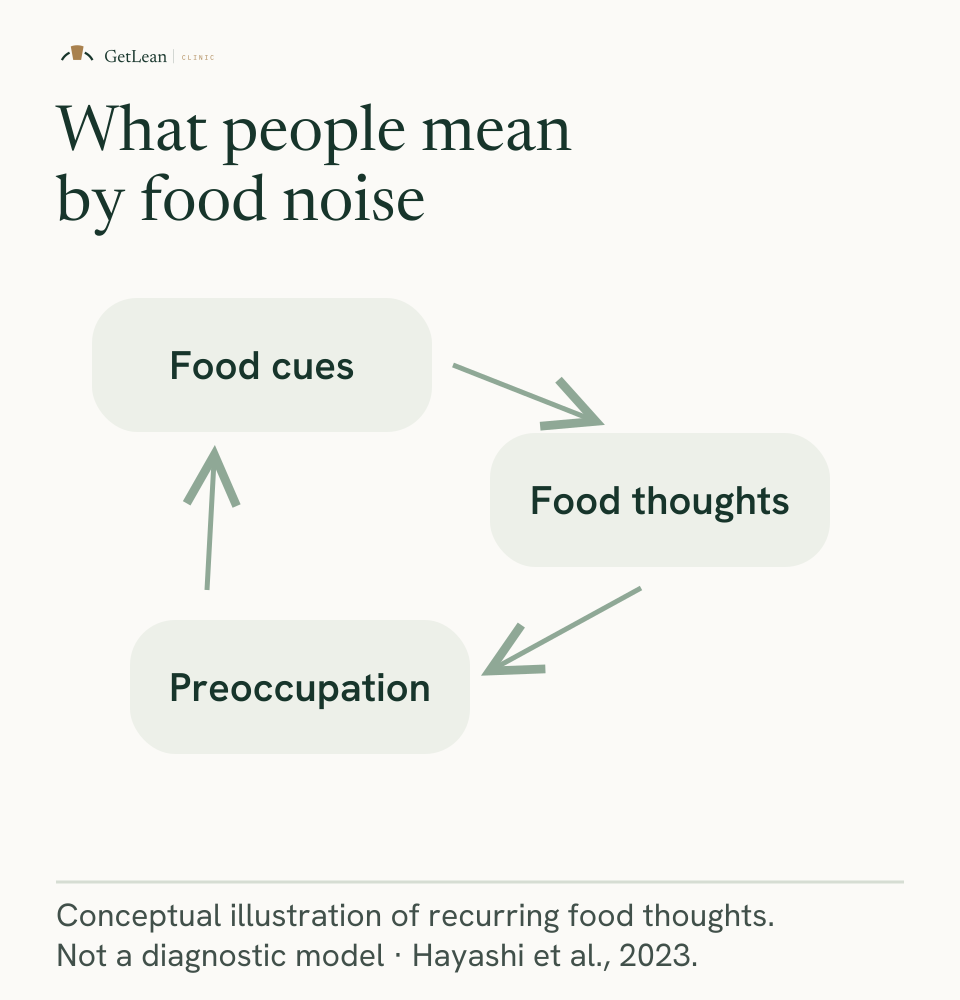
Food noise: a patient-derived term for persistent, intrusive preoccupation with food. Not a diagnosis, and not something with a long research history.
Where the term came from
Not from a laboratory. From people describing their own experience, and clinicians hearing the same description repeatedly.
The founding academic treatment is a 2023 narrative review, which proposed a conceptual model for the phenomenon. It was explicitly motivated by patient and clinician reports of reduced rumination and preoccupation with food on GLP-1 medication, and it stated that systematic investigation and a means of measurement were still needed (Hayashi 2023).
Read that carefully. The founding paper is a review proposing a model, not a study measuring a thing, and its own conclusion is that a means of measurement was still required.
Two years later, a 2025 review restated the position: "a formal clinical definition and method of measurement of food noise are lacking", and proposed one — persistent thoughts about food perceived by the individual as unwanted or distressing and potentially harmful (Dhurandhar 2025).
When it became measurable
In 2025, and there are now competing instruments rather than one settled tool.
A validation study published that year produced the Food Noise Questionnaire, with a Cronbach's alpha of 0.93 across 396 analysed participants and test-retest reliability of 0.79 in a 150-person subsample — and its authors stated that no validated questionnaire for this had existed before (Diktas 2025). A different review published the same year proposed a separate instrument.
So the field has two early tools, published two years after the term entered clinical conversation and well after GLP-1 medication came into wide use.
What follows from that: no GLP-1 trial has measured "food noise" as such, because there was nothing validated to measure it with while those trials were running. Anyone describing "clinically validated food-noise reduction" is describing something that does not exist yet.
What trials did measure
Related things, with instruments that existed at the time, and the findings are real.
In a crossover trial, semaglutide reduced total food intake across a single laboratory test day by about 24% versus placebo, and participants reported less hunger and food craving, better control of eating, and a lower preference for high-fat foods (Blundell 2017). That intake figure comes from a laboratory test day rather than tracked daily eating.
In the STEP 5 sub-study, craving-control scores on a self-report eating-control questionnaire improved significantly versus placebo at weeks 20, 52 and 104, all p<0.01 (STEP 5 sub-study). Those are mean differences on a questionnaire, in people also losing weight — not the elimination of cravings, and the instrument's own authors describe its validation as preliminary.
So the accurate summary is: measures adjacent to food noise improved on treatment, in trials, versus placebo. That is meaningfully different from "the medication quietens food noise", and meaningfully more than nothing.
Why it plausibly happens
GLP-1 receptor signalling acts on appetite regulation as part of how the medication works (Drucker 2018). Appetite regulation is not only about the physical sensation of hunger — it involves how much attention food commands.
So a mechanism exists that could produce the reported experience. What has not happened is a study measuring the specific reported experience against that mechanism. The gap between "plausible and widely reported" and "measured" is where this topic sits, and it is a normal place for a young construct to be.
We cover the underlying mechanism in how GLP-1 medications work.
What happens to food noise after stopping GLP-1?
It has not been measured after stopping, so what can be said comes from how long the medicine stays in the body. No validated food-noise questionnaire existed until 2025 (Diktas 2025), and the withdrawal trials, the STEP 1 extension, STEP 4 and SURMOUNT-4, report body weight and cardiometabolic measures, not hunger, craving or food intake after stopping (Wilding 2022, Rubino 2021, Aronne 2024).
What the labels do show is how long the medicine lingers. Semaglutide's elimination half-life is about one week, and it is present in the circulation for about five to seven weeks after a last 2.4 mg dose; tirzepatide's half-life is about five to six days (label, label). So any quieting that comes from the medicine's effect on appetite can be expected to fade over the weeks after the last dose. Appetite after stopping covers the rest of what was and was not measured.
What helps is having the eating pattern in place before the last dose rather than after it. In a Copenhagen randomised trial that followed adults for a year after treatment ended, those who had combined a GLP-1 medication with supervised exercise were more likely than those who had taken the medication alone to still hold a loss of at least 10% of their starting weight (Jensen 2024). At GetLean the quieter period is used to build those habits with daily WhatsApp coaching, and under the GetLean GLP-1 Taper Plan the dose is stepped down at Dr Quek's monthly reviews rather than stopped overnight, so appetite can adjust gradually. Individual results vary.
Why the distinction matters
"Food noise" has become a marketing phrase, and it is the kind of claim that inflates easily.
The claim of clinical proof that GLP-1 medication quietens food noise is false in a specific and checkable way: the measurement tools postdate the trials. What the trials measured is set out above. The reported experience stands as what it is — widely reported, plausible, and not yet formally studied under that name.
If you experience it, that experience is not invalidated by the literature being young. Patients described this before researchers had a word for it, which is how a good deal of clinical knowledge starts.
At GetLean, the programme is designed to end, and our philosophy is that the medication is the catalyst and what you keep is the result. The plan for coming off is the GetLean GLP-1 Taper Plan: after hitting your goal weight with the right nutrition and exercise habits built, the dose is stepped down at Dr Quek's monthly reviews towards your lowest effective dose and, where clinically appropriate, off the medication. Quieter food noise, if you get it, is a window rather than an outcome — the period in which building a different pattern of eating is easier than it will be later.
Individual results vary, and clinical-trial figures describe the populations studied.
Read the transcript
“Why are my cravings returning while I’m still taking GLP-1?”
This is a question I hear often from my patients at GetLean.
It can feel discouraging when food is back on your mind after a quieter period. But that change alone does not tell me the medication has stopped working. I would want to understand what has changed before deciding what to do.
First, what does “cravings returning” mean for you? Are you hungry before meals again? Thinking about a particular food in the evening? Or finding that a portion which used to satisfy you no longer does? Those are different experiences. A few days after a late night or a stressful week also tells a different story from a pattern that has continued for weeks.
GLP-1 treatment can affect appetite and fullness. It does not remove every normal cue to eat, and the aim is not to feel no hunger at all. So I would look at the pattern, not declare failure from one difficult day.
I would ask when you noticed the change, what you are eating across the day, and whether the treatment has been taken as prescribed. If your lunch has become tiny because you are busy at work, a strong appetite by the time you reach home may deserve a different conversation from a steady increase in appetite despite regular meals. Sleep, stress, and your activity can also be useful context. None of these questions is an accusation; they help make the review specific to you.
At GetLean, you can log meals with our WhatsApp AI assistant as the day happens. It shows estimated calories and protein against your daily targets, giving us a record to discuss.
Then I would look at the broader picture. How is your weight trend over time? How are you feeling on treatment? Are there side effects making it hard to eat normally? Is the current plan still helping you with the goals you and your doctor agreed on? Cravings are one piece of that picture, not a diagnosis by themselves.
Please do not change a prescribed dose on your own because an evening felt harder. Your prescriber can review the pattern, check how you are using the medicine, and decide whether any part of the plan needs to change. If hunger has returned alongside symptoms that worry you, tell your doctor about both.
So my answer is: notice the change, and jot down when it happens, what you had eaten, and whether you felt hungry or wanted a particular food. Bring that pattern to a treatment review. It gives us a clearer starting point than one difficult evening.
Common questions
What does food noise mean?
The persistent, intrusive preoccupation with food that many people describe. A 2025 review proposed defining it as persistent thoughts about food perceived by the individual as unwanted or distressing and potentially harmful (Dhurandhar 2025).
Is food noise a real medical condition?
It is a patient-derived term, not a diagnosis. The 2023 narrative review that introduced it academically proposed a model and said measurement was still needed (Hayashi 2023); the first validated questionnaire appeared in 2025 (Diktas 2025).
Does GLP-1 medication reduce food noise?
No trial has measured food noise as such, because no validated measure existed until 2025. Related measures did improve — craving-control scores were significantly better than placebo in the STEP 5 sub-study (STEP 5), and participants reported less hunger and better control of eating in an earlier trial (Blundell 2017).
Why do so many people describe the same thing?
Because the term named an experience people recognised. That is how it reached the literature — patient and clinician reports first, formal study afterwards (Hayashi 2023).
Does food noise come back if you stop?
Food noise is reported to quieten while the medication is acting on appetite, so once the medication is stopped, that effect can be expected to fade as it clears over the following weeks, and the eating habits in place by then are what is left. At GetLean, the quieter period is used to build those habits with daily WhatsApp coaching, and the dose is stepped down at Dr Quek's monthly reviews rather than stopped overnight, so appetite can adjust gradually. More in appetite after stopping.